
Short answer: A breakup after a long relationship hurts in a different way, because you’re not only losing a partner but also your routines, your shared future and part of who you are. Recovery usually takes longer and comes in waves. What helps most is handling the practical untangling in small steps, rebuilding a sense of yourself outside “us,” and giving yourself many months, not weeks, without judging the pace.
Seven years. Two flats. A dog, a group chat with their family, a shared Netflix password, a plan for where you’d live when you had kids. And now you’re lying in a half-empty bedroom wondering how you’re supposed to start again at 31. If that’s roughly where you are, this guide is for you.
Why ending a long relationship hits so hard
You built an identity together
After years together, “I” quietly becomes “we.” You know which side of the bed is yours, what you’d cook on Sundays, who you’d call first. Slotter, Gardner and Finkel (2010, Personality and Social Psychology Bulletin) found that breakups can shake people’s self-concept clarity, their sense of who they are, and that this confusion was linked to emotional distress after the breakup. The longer and closer the relationship, the more of you is tangled up in it.
Closeness and time predict more distress
This isn’t just a feeling. In a classic study, Jeffry Simpson (1987, Journal of Personality and Social Psychology) found that people who had been closer to their partner and together longer tended to feel more distress after the relationship ended. So if it feels bigger than your friends’ breakups, it probably is.
You’re losing the future, not just the past
Long relationships carry plans: a wedding, a house, children, growing old. When it ends, you grieve all the versions of life that won’t happen. That’s why you might feel fine at work and then fall apart walking past a pram in the park.
The practical loss is huge
Short relationships end with a box of stuff. Long ones end with a lease, a joint account, mutual friends, pets, sometimes in-laws you loved. Each practical task is also an emotional one.
What recovery tends to look like
There’s no exact timeline, and recovery doesn’t move in a straight line. But many people go through something like this:
| Phase | What it often feels like | What helps |
|---|---|---|
| The first weeks | Shock, numbness, crying at random times, struggling to eat or sleep | Basics: food, sleep, one person to check in with daily. Minimal decisions. |
| The first few months | Waves of grief, anger, bargaining. Logistics feel endless | Handle one practical task at a time. Set up a routine that’s yours. |
| Months three to twelve | Good days start outnumbering bad ones, but anniversaries and holidays sting | Plan ahead for hard dates. Try new things that belong only to you. |
| A year and beyond | The relationship becomes a chapter rather than your whole story | Reflect on what you learned. Decide what you want next. |
For a closer look at the weeks, see our week-by-week breakup recovery timeline, and for the honest answer on time, how long it takes to get over a breakup.
The thoughts that keep you stuck
“I wasted years of my life.”
This is one of the most common and most painful thoughts after a long relationship. But those years weren’t empty. You grew up in them, learned what you need, and loved someone. Tashiro and Frazier (2003, Personal Relationships) found that people often reported personal growth after a breakup, like greater self-confidence and clearer ideas of what they wanted. A relationship ending doesn’t mean it failed. It means it finished.
“I’m too old to start over.”
You’re not starting from zero. You’re starting with years of self-knowledge you didn’t have at 22. Plenty of people meet partners, change careers and build new lives in their 30s, 40s and beyond.
“Nobody will ever know me like they did.”
That’s true in one sense: nobody else will share those exact years. But being known is something you can build again, with friends, family and eventually someone new. The capacity you used to love them is still yours.
“Maybe we should try again.”
Missing someone you were with for years is completely normal and doesn’t automatically mean the breakup was wrong. Often you miss the comfort and familiarity more than the actual relationship. Write down the reasons it ended, in your own words, while they’re fresh. Read them when nostalgia hits.
Handling the practical side without falling apart
The logistics can feel overwhelming. Break them into a list and do one thing a day, not ten.
- Where you’ll live. If you’re still under the same roof for now, set clear house rules. Our guide to no contact when you live or work together covers this.
- Money. Separate joint accounts, subscriptions and shared bills. Change passwords on streaming and shopping accounts.
- Belongings. Agree on a single day for swapping things, ideally with a friend present. Box up anything too painful to look at and store it out of sight.
- Pets. Decide based on what’s best for the animal and who can realistically care for it.
- Friends and family. Let mutual friends know they don’t have to pick sides, and that you’d rather not hear updates for now.
- Their family. If you were close to their parents or siblings, it’s okay to send a kind goodbye message and step back for a while.
Try to keep these conversations short, practical and in writing where possible. For example: “Can we agree on Saturday the 14th for the rest of the things? I’ll leave the keys with Jess.” Save the feelings for someone who isn’t your ex.
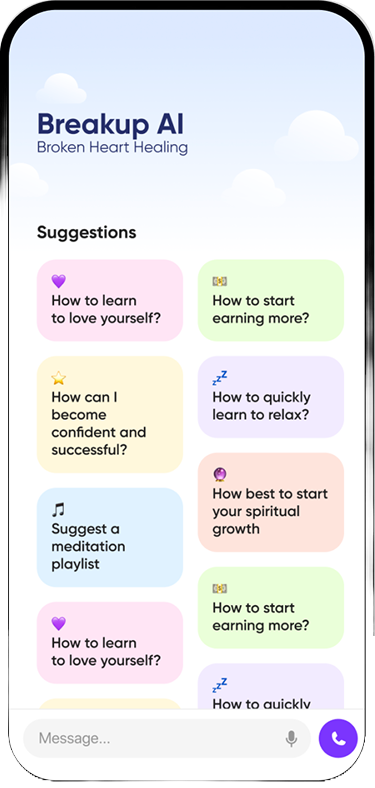
Want to text them every time you open the shared bank app? Open the SOS button in Breakup AI before you type anything. It walks you through the next few minutes and counts your no-contact days.


Rebuilding yourself after “us”
The deepest work after a long relationship is remembering who you are on your own. Some ways to start:
- Reclaim your space. Move the furniture. Buy new sheets. Make your home look like you live there, not like someone left.
- Make one routine that’s only yours. A Saturday morning swim, a Tuesday class, a new walk to work.
- List what you gave up. Hobbies, friends, music, food you stopped eating because they didn’t like it. Bring one back each month.
- Answer the “who am I” questions. What do I enjoy when nobody’s watching? What do I want my weekends to look like? What did I always want to try?
- Lean on the people who knew you before. Old friends often remember a version of you that you’ve lost touch with.
Research by Lewandowski and Bizzoco (2007, Journal of Positive Psychology) found that some people, particularly those leaving relationships that had become less fulfilling, reported positive emotions and growth after the breakup, including rediscovering parts of themselves. You don’t have to feel that yet. It’s simply evidence that it’s possible.
Try this tonight:
- Write a list of five practical tasks. Circle the smallest one. Do only that one tomorrow.
- Move one thing in your home that reminds you of them out of sight.
- Write down one thing you used to love before the relationship and haven’t done in years.
- Message one person who knew you before you were a couple. Keep it light: “Thinking of you. Fancy a coffee soon?”
Grief comes in waves, and that’s normal
Many people describe feeling better for a few weeks and then getting knocked flat by a song, a smell or a date. That’s not going backwards. Grief after a long relationship often comes in waves for a long time before it settles. Our guide to the stages of a breakup explains why the feelings can loop.
Plan ahead for the dates you know will be hard: your anniversary, their birthday, the first holidays apart. Have something booked, and someone to be with.
When to think about dating again
There’s no rule, but a good sign is wanting to meet someone because you’re curious about them, not because you want to stop feeling the loss. If you’re still crying about your ex most days, it’s probably too soon. You’ll find a simple test in our guide to when to start dating again.
When to get extra support
A long relationship ending is one of life’s major stressors. If you can’t function at work, you’re not eating or sleeping for weeks, or you’re drinking more to cope, please speak to your doctor or a therapist. You don’t have to be falling apart to deserve help. If you ever feel unsafe, in the US call or text 988, and in the UK call Samaritans on 116 123.
FAQ
How long does it take to get over a long-term relationship?
There is no fixed rule, but recovery from a long relationship often takes many months and can take a year or more, especially with shared homes, finances or friends. Research suggests longer and closer relationships tend to cause more distress when they end, so a slower recovery is normal.
Why is a breakup after a long relationship so hard?
Because you lose more than a partner. You lose routines, shared plans, often a home and friendships, and part of your identity. Studies on self-concept show that breakups can leave people unsure of who they are, which adds to the pain.
Is it normal to miss my ex after years together even if I ended it?
Yes. Missing someone you spent years with is normal and does not mean you made the wrong choice. You may miss the comfort and familiarity as much as the person. Writing down why it ended helps when nostalgia hits.
Did I waste years in a long relationship that ended?
Those years were not wasted. You grew, learned what you need and loved someone. Research on post-breakup growth finds many people report greater self-confidence and clearer goals after a relationship ends.
How do I start over after a long relationship at 30 or older?
Start small. Handle one practical task at a time, build one routine that is only yours, reconnect with friends who knew you before, and bring back hobbies you dropped. You are not starting from zero; you are starting with much more self-knowledge.