
Short answer: The 90-second rule says the physical surge of an emotion passes in about a minute and a half if you don’t keep feeding it with thoughts. For the urge to text your ex, that means you don’t have to defeat the craving, only outlast its peak: notice it, name it, breathe slowly and feel it in your body for 90 seconds without acting. If it comes back, you ride the next wave the same way, and each one tends to be a little smaller.
The craving usually arrives out of nowhere. You’re fine, you’re making pasta, and then a song comes on and your whole body leans toward your phone. In that moment it feels like the urge will only get bigger until you give in. That feeling is the lie the 90-second rule is designed to expose.
Where the 90-second rule comes from (and what it isn’t)
The idea was popularised by Jill Bolte Taylor, a Harvard-trained neuroanatomist, in her 2008 book My Stroke of Insight. She describes how, when an emotion like anger or fear is triggered, a burst of chemistry floods the body, and within about 90 seconds that initial surge has run its course. If the feeling continues after that, she argues, it’s usually because we’re replaying the thoughts that set it off, re-triggering the loop.
It’s worth being honest: the “90 seconds” is a useful rule of thumb from her experience and knowledge of the brain, not a precise number from a controlled experiment. Your urge might crest in 40 seconds or in three minutes. What matters is the shape: emotional surges rise, peak and fall, and they fall faster when you stop adding fuel.
That shape has good support. In addiction research, a technique called urge surfing, developed by psychologist Alan Marlatt, teaches people to observe a craving like a wave instead of fighting it or obeying it. In a study of college smokers, Sarah Bowen and Alan Marlatt (2009, Psychology of Addictive Behaviors) found that a brief urge-surfing instruction led people to smoke fewer cigarettes over the following week, even though their urges weren’t necessarily weaker. They had the same urges; they just acted on them less.
Why this works so well for the urge to text your ex
When Helen Fisher and colleagues scanned people who’d recently been rejected (Fisher et al. 2010, Journal of Neurophysiology), looking at their ex activated brain regions tied to reward, motivation and craving. In plain terms, missing your ex can behave a lot like a craving for a substance. It comes in waves, it’s triggered by cues (songs, places, their name), and it promises relief if you just give in once.
If you want to go deeper on the brain side of all this, our explainer on the psychology behind the no contact rule covers it. The practical takeaway is simple: you can’t stop the wave from arriving, but you don’t have to surf it all the way into a text message.
The 90-second protocol, step by step
Practise this a few times when the urge is small, so it’s familiar when the urge is big.
- Catch it and say it. Out loud or in your head: “This is an urge to text Alex.” Naming it creates a tiny gap between you and the feeling. Research by Matthew Lieberman and colleagues (2007, Psychological Science) found that putting feelings into words reduced activity in the amygdala, the brain’s alarm system.
- Put the phone down, face down. Out of your hand, ideally out of reach. You’re not banning it forever, just for the next 90 seconds.
- Start a timer. Most phones’ clock app works. Watching seconds tick by proves to your brain that this has an end.
- Breathe slower on the way out. A double inhale through the nose followed by a long, slow exhale (sometimes called a cyclic or physiological sigh) is an easy pattern. In a Stanford study (Balban et al. 2023, Cell Reports Medicine), five minutes a day of this kind of breathing improved mood more than the same time spent on mindfulness meditation. You don’t need five minutes right now; a few rounds will do.
- Find it in your body. Where is the urge? Tight chest, buzzing hands, a hollow stomach, heat in your face? Describe it like a curious scientist: “Pressure behind my ribs, about a 7 out of 10.”
- Watch it move. Every 20 or 30 seconds, rate it again. You’re looking for the moment it starts to drop, even slightly: 7, 8, 8, 6, 5.
- Choose your next move. When the timer ends, decide what you’ll do with the next ten minutes. Not “text them or don’t,” but “shower, call my sister, or start a show.”
Try this tonight: Practise on a small urge first. The next time you feel even a mild pull to check their profile or reread your old messages, run the 90-second protocol once, and rate the urge out loud every 30 seconds. Write down the numbers. Seeing “7, 8, 6, 4” in your own handwriting is powerful evidence for the next big wave.
What if 90 seconds isn’t enough?
Sometimes the urge drops, and two minutes later it’s back. That’s normal, especially in the first days of no contact. Cravings come in sets, like waves on a beach. The trick is to stop thinking of it as one long battle and start thinking of it as several short ones, each a little easier.
When one round isn’t enough, step up the ladder:
| If the urge… | Do this |
|---|---|
| Fades after one round | Great. Do something that uses your hands for a few minutes so it doesn’t flare again. |
| Comes back within minutes | Run another 90 seconds. Then change rooms or go outside; a new environment breaks the cue. |
| Keeps returning for an hour | Delay, don’t decide. Tell yourself, “If I still want to text them in 24 hours, I’ll think about it properly.” Then write the message in your notes instead. |
| Is tied to a big trigger (their birthday, seeing them with someone) | Bring in a person: text a friend, call family, or use a support tool. Big waves are easier with company. |
| Comes with panic, hopelessness or thoughts of self-harm | This is more than a craving. Reach out now. In the US, call or text 988. |
The first week tends to be the roughest. If you’re right at the start, our guide to the first day of no contact will help you plan for it.
Three real moments, and how the rule plays out
The story you shouldn’t have watched
You see their story: they’re at a bar you used to go to together. Your thumb is already on “Reply.” Instead: phone face down, “This is an urge to reply to Sam’s story,” timer on. Breathe out long. The urge is a 9, mostly heat in your face. By 60 seconds, it’s a 7 and you’re thinking more clearly: replying to a story is how you’d end up in a conversation you don’t want. At 90 seconds you mute their stories. Done.
The supermarket song
Their favourite song plays while you’re buying milk. You can’t put your phone across the room in a shop, so you put it in your bag. Name it: “Urge to text Mia that I heard our song.” Feel your feet on the floor while you breathe. Rate it, keep walking, pay, leave. By the car, it’s a 4. You text your friend instead: “Our song just played in the supermarket, life is cruel.”
1am in bed
This is the hardest one. You’re tired, it’s quiet and your defences are low. Nights have their own rules, so our guide to the urge to text your ex at night covers them in detail. For the 90 seconds: get out of bed (staying in bed with the urge makes it worse), go to another room, run the protocol, then do something boring and low-light until you’re sleepy.
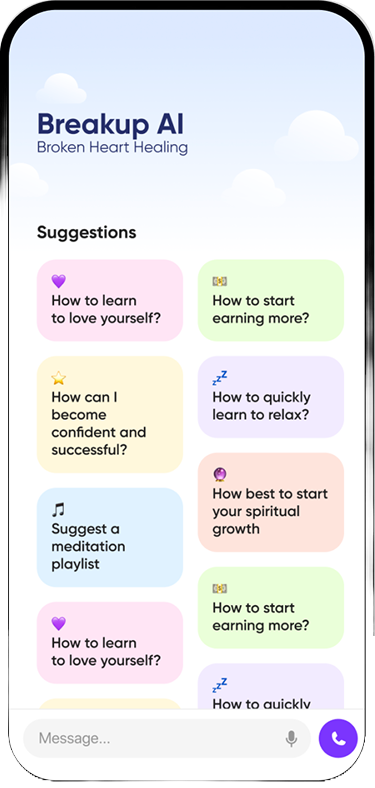
Riding a wave right now? Open the SOS button in Breakup AI before you type anything. It walks you through the next few minutes and counts your no-contact days.


Common mistakes that make the urge last longer
Fighting the thought
“Don’t think about them, don’t think about them.” That tends to backfire. In classic experiments by Daniel Wegner and colleagues, people told not to think about something ended up thinking about it more, and a follow-up study (Wegner & Gold 1995) looked at exactly this kind of suppression with thoughts of a past relationship. The 90-second rule is about letting the feeling be there without obeying it, not about forcing it away.
Using the 90 seconds to draft the text
If you spend the whole time composing the perfect message in your head, you’re not surfing the urge, you’re feeding it. When you notice yourself drafting, bring your attention back to your breath and your body.
Scrolling to distract yourself
Opening Instagram to “take your mind off it” usually leads straight back to their profile. Choose a distraction that isn’t connected to them: a walk, a shower, music they never listened to.
Judging yourself for having the urge
Having the urge isn’t failure. It’s what a heart that was attached does. The only thing you’re practising is not acting on it right now. If you do slip, that’s information, not a verdict. Our guide on how to stop texting your ex includes a plan for after a slip.
Why it gets easier
Each time you ride out an urge without acting on it, you teach your brain something new: this feeling is uncomfortable, but it passes, and nothing terrible happens when I don’t obey it. Over weeks, the waves usually arrive less often and with less force. They may still spike on anniversaries or after unexpected reminders, but you’ll have proof, in your own experience, that you can get through them.
If the cravings come with a racing heart, tight chest or panic, you might be dealing with anxiety as well as longing. Our guide to anxiety and panic after a breakup has more tools for that.
FAQ
What is the 90-second rule for emotions?
It’s an idea popularised by neuroanatomist Jill Bolte Taylor in her book My Stroke of Insight: the chemical surge of an emotion passes through the body in about 90 seconds, and if the feeling lasts longer, it’s usually because our thoughts keep re-triggering it. It’s a helpful rule of thumb rather than a precise lab measurement.
Does the 90-second rule really work for cravings?
The general principle has support. Urge surfing, a related technique from addiction research, helped smokers in a 2009 study by Bowen and Marlatt smoke fewer cigarettes, even though their urges weren’t necessarily weaker. You may need more than one round, but cravings do tend to rise, peak and fall.
How do I stop the urge to text my ex?
You usually can’t stop the urge from showing up, but you can stop acting on it. Name the urge, put your phone out of reach, breathe slowly and rate the feeling every 30 seconds for about 90 seconds. Then choose a specific next activity. Repeat if the urge returns.
What if the urge comes back after 90 seconds?
That’s normal. Cravings come in waves, especially early on. Run another round, change rooms or go outside, and if it keeps returning, delay any decision for 24 hours and write the message in your notes instead of sending it.
What should I do during the 90 seconds?
Put the phone down, name the urge, breathe with a long slow exhale, notice where you feel it in your body and rate its intensity every 20 to 30 seconds. Avoid scrolling or mentally drafting a message, because both feed the craving.