
Short answer: The first day of no contact is usually one of the hardest, because your brain is used to them being one tap away. Expect strong urges, phone checking, and a wave of doubt by evening. Your only job today is to not contact them: mute or archive the chat, tell one friend, plan your evening, and have something ready to do the moment the urge hits.
If you’re reading this on day one, maybe in bed, maybe with their chat open in another tab: you don’t need to fix your whole life today. You don’t need to feel better today. You need to get to tomorrow morning without sending a message. That’s the whole assignment.
Here’s what today is likely to feel like, why, and exactly what to do with each part of it.
Why day one feels so intense
It isn’t weakness. It’s biology. When Helen Fisher and colleagues scanned people who’d recently been rejected by someone they still loved (Fisher et al., 2010, Journal of Neurophysiology), the brain regions that lit up overlapped with those involved in reward, craving, and addiction. A separate study by Ethan Kross and colleagues (2011, PNAS) found that looking at an ex who’d broken up with you activated some of the same brain regions involved in physical pain.
So on day one you’re dealing with something that genuinely resembles withdrawal and genuinely registers as pain. Of course you want to text. Texting is the thing your brain has learned will make the feeling stop, for about five minutes.
Day one, hour by hour: what to expect
| Time | What it often feels like | What to do |
|---|---|---|
| Morning | Waking up and remembering. Reaching for your phone to check for messages. | Keep your phone out of reach for the first 15 minutes. Get up, water, shower, light. |
| Midday | Distracted, foggy. Reflex urges to share small things with them. | Text a friend instead. Eat something, even if you’re not hungry. |
| Afternoon | Second-guessing. “Maybe I’m overreacting.” Drafting texts in your head. | Write the draft in your notes app, not the chat. Don’t send it. |
| Evening | Usually the peak. Loneliness, nostalgia, the urge to “just check in.” | Have a plan already: a person, a show, a walk, a call. Don’t be alone with nothing. |
| Late night | Bargaining. Old photos. The “one last message” fantasy. | Phone charging outside the bedroom if you can. See our guide to the urge to text your ex at night. |
Not everyone follows this pattern. Some people feel weirdly fine on day one and get hit on day three. That’s normal too.
Your day one checklist
Do these in the first few hours. Each one removes a bit of friction between you and a text you’ll regret.
- Archive or mute the chat. You don’t have to delete anything today. Just get it off your main screen so you don’t see their name every time you open the app.
- Mute their social accounts. Unfollow if you’re ready. Mute if you’re not. You’re not making a statement, you’re protecting your attention. Our guide on whether to unfollow, mute or block can help you decide.
- Rename their contact. Something neutral like “Don’t” or “Not tonight.” A tiny pause can be enough.
- Tell one person. “I’m starting no contact today. If I message you saying I want to text them, remind me why I’m doing this.” That’s it.
- Write your reason down. One or two sentences in your phone notes. You’ll need it at 11pm when your brain starts arguing.
- Plan tonight. Not a vague “I’ll be fine.” A specific plan: who you’ll talk to, what you’ll watch, when you’ll go to bed.
- Decide what counts. Texting, calling, DMing, liking, viewing Stories, asking mutual friends about them. Decide now so you can’t renegotiate later.
When the urge hits: a 3-minute plan
The urge to text usually comes in waves. It builds, peaks, and passes, often faster than you expect if you don’t act on it. Addiction researchers call riding it out “urge surfing”; Bowen and Marlatt tested a brief version with smokers in 2009 (Psychology of Addictive Behaviors) and found it helped people act on cravings less.
When it hits:
- Name it. Say, out loud or in your head, “This is an urge. It will pass.” Putting feelings into words can reduce their intensity; Matthew Lieberman’s lab showed this “affect labelling” effect in a 2007 Psychological Science study.
- Breathe slowly for one minute. In for four, out for six. Longer exhales help your body settle.
- Move. Stand up, change rooms, step outside. Physical movement breaks the loop between thought and thumb.
- Redirect the words. Write what you wanted to say in your notes, or say it to someone safe. The feeling gets expressed without reopening contact.
For a longer list of what to do with your hands and your evening, see 30 things to do instead of texting your ex.
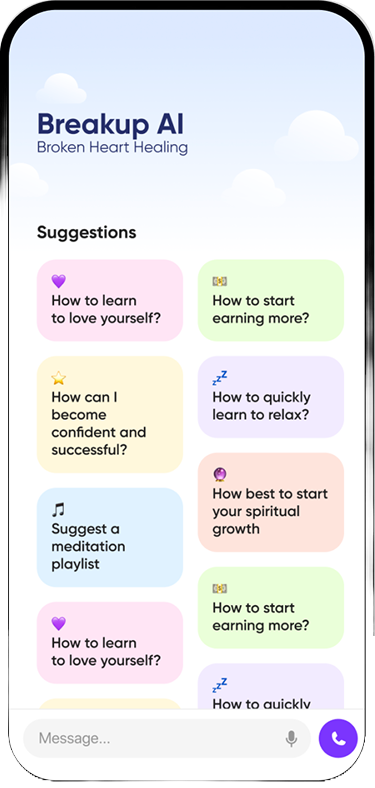
Day one and already want to text them? Open the SOS button in Breakup AI before you type anything. It walks you through the next few minutes and starts counting your no-contact days from today.


The texts you’ll want to send today (and why not to)
Day one urges usually come dressed up as reasonable messages. Here are the most common, and what’s really going on underneath.
| The text | What it’s really about |
|---|---|
| “I just want you to know I’m doing no contact, it’s not personal.” | Wanting them to react to your silence. Announcing it isn’t required. |
| “Can we talk one more time? I need closure.” | Hoping the conversation goes differently this time. Closure rarely comes from them. Our guide on moving on without closure explains why. |
| “Hope you’re okay.” | Checking they still care. Any reply, or no reply, will hurt. |
| “You left your hoodie here.” | A logistical excuse. Belongings can wait a week or go via a friend. |
| “I’m sorry for everything.” | Guilt, and wanting relief. If an apology is genuinely owed, it’ll still be valid in a month, from a calmer you. |
Do you need to tell your ex you’re starting no contact? Usually no. If you still have practical things to sort out, like a shared bill or a key, you can send one brief message: “I need some space so I won’t be in touch for a while. Can you leave my key with Sam?” Then stop.
What not to do on day one
- Don’t make big decisions. No quitting jobs, moving cities, or burning every photo tonight. Archive, don’t destroy.
- Don’t drink to cope. Alcohol lowers impulse control, and drunk texts are among the most regretted messages there are.
- Don’t stalk “just once.” Checking their profile restarts the craving you’re trying to let fade.
- Don’t spend the whole evening alone with your phone. Be with someone, call someone, or at least be somewhere that isn’t your bed.
- Don’t judge yourself for how you feel. Feeling awful on day one doesn’t mean no contact isn’t working. It means it’s starting.
Getting through the first night
Night is usually the hardest part of day one. You’re tired, it’s quiet, and your defences are down.
- Charge your phone across the room or outside the bedroom.
- Put on something familiar and low-stakes: a comfort show, a podcast, an audiobook.
- If you can’t sleep, get up for a bit rather than lying there scrolling. Sleep loss makes emotions harder to regulate; research from Matthew Walker’s lab (Yoo et al., 2007, Current Biology) found sleep-deprived people showed much stronger amygdala reactions to negative images.
- If thoughts get dark, reach out. In the US, call or text 988. In the UK, Samaritans are on 116 123.
Try this tonight: your “if-then” plan (5 minutes)
Psychologist Peter Gollwitzer’s research on “implementation intentions” (American Psychologist, 1999) shows that deciding in advance exactly what you’ll do in a specific situation makes you much more likely to follow through. Write three of these in your notes:
- “If I pick up my phone to text them, then I will open my notes and write it there instead.”
- “If I start looking at old photos, then I will put the phone down and make a cup of tea.”
- “If I’m still awake at midnight and want to message them, then I will text [friend’s name] or do a one-minute breathing exercise.”
What happens after day one
Day two often feels as hard, sometimes harder. Days three to seven usually bring waves rather than a constant flood. Most people notice the urges get a little shorter by the end of the first week, even if they’re no less painful. Our no contact day-by-day guide walks through what’s typical for days 1 to 30.
Tonight, though, don’t think about day 30. Think about tomorrow morning. Every no contact streak that ever lasted started with exactly the day you’re having right now.
FAQ
Is the first day of no contact the hardest?
For many people, the first few days are the hardest, because the habit of contacting your ex is strongest and nothing has had time to fade yet. Some people feel numb on day one and struggle more on days two to four. Both patterns are normal.
Should I tell my ex I’m starting no contact?
You don’t have to. If there’s something practical to sort out, you can send one short message saying you need space and won’t be in touch for a while, then stop. Avoid long explanations, which often reopen the conversation.
Should I delete their number on day one?
You don’t need to. Muting or archiving the chat and renaming the contact usually works just as well and avoids decisions you might regret. If you know you’ll text them otherwise, deleting or blocking is reasonable.
What should I do on the first day of no contact?
Mute or archive the chat, mute their social media, tell one friend, write down why you’re doing it, plan your evening, and prepare what you’ll do when an urge hits. Your only goal is to get to tomorrow without contacting them.
Does no contact start from the breakup or from the last message?
It starts from the last time you contacted them, by any channel. If you messaged them this morning, today is day zero and tomorrow is day one.
Is it normal to cry all day on day one of no contact?
Yes. Crying, numbness, anxiety, and not eating much are all common in the first days. If it continues for weeks or you’re struggling to function, talk to a doctor or therapist, and if you’re in crisis in the US, call or text 988.