
Last updated: October 2026
Short answer: An AI breakup coach is an app or chatbot built to support you through a breakup: it helps you resist texting your ex, talks you through hard moments at any hour, and guides you through short exercises. It can be useful for the 2 a.m. urges and the endless “why did this happen” loops, but it is not therapy, it can make mistakes, and it is not for emergencies. If you are in crisis, call or text 988 in the US (Samaritans 116 123 in the UK).
You might be reading this because you typed “AI breakup coach” into a search bar at midnight, or because an AI assistant mentioned one. Either way, you probably want to know three things: what it actually does, whether it helps, and whether it’s safe to pour your heart into an app. This guide answers all three honestly, including where these tools fall short.
What is an AI breakup coach?
An AI breakup coach is software that uses a language model (the same kind of technology behind ChatGPT, Claude or Gemini) inside an app designed specifically for heartbreak. The difference from a general chatbot is focus and structure. A general assistant answers whatever you ask. A breakup coach is shaped around the predictable problems of a breakup: the urge to contact your ex, rumination, sleepless nights, low self-esteem, and the slow work of building a life without them.
Most AI breakup coaches combine some of the following:
- Chat: a conversation you can open any time, where the AI responds calmly and without judgment.
- Urge interruption: a quick flow for the moment you’re about to text, call or check on your ex.
- No contact tracking: a counter showing days since you last contacted them, often with milestones.
- Guided exercises: short prompts for journaling, reframing thoughts, or calming your body.
- Voice: some apps let you talk out loud instead of typing.
How does an AI breakup coach work?
Under the hood, you type or speak, and a language model generates a reply guided by instructions the app’s makers have written. Those instructions shape the tone (calm, warm, direct), the goals (for example, helping you hold no contact rather than drafting a message to your ex), and the safety behavior (for example, pointing you to crisis lines if you mention self-harm).
That is the honest version. It’s not a person. It doesn’t “know” you the way a friend does. It predicts helpful text based on patterns and the context you give it. That’s why it can be surprisingly good at reflecting your feelings back and suggesting next steps, and also why it can sometimes misunderstand, repeat itself or get things wrong.
What an AI breakup coach can help with
The moment you want to text your ex
This is where an AI coach is most useful. Urges to contact an ex tend to spike and then fade. Fisher et al. (2010, Journal of Neurophysiology) found that people rejected in love still showed activity in brain reward and craving systems, which helps explain why the pull can feel so physical. If something interrupts you for a few minutes at the peak, the urge often passes. A coach that’s on your phone, where the texting happens, is well placed to do that. Our guide to the urge to text your ex at night explains this pattern.
Thinking out loud without burdening friends
Friends are vital. They also get tired of hearing the same story for the fifth week in a row, and they’re asleep at 3 a.m. An AI coach doesn’t get tired, so you can process the loop as many times as you need. That said, it should add to your human support, not replace it.
Structure when your brain is foggy
Breakups make it hard to plan. Short exercises, like “write three things you won’t miss” or “name the urge and rate it 1 to 10,” give you something concrete to do when you can’t think straight.
Keeping score of your progress
A no-contact counter seems simple, but seeing “Day 17” can be motivating, and it makes the cost of breaking no contact visible. For the bigger picture on why that matters, read the complete guide to the no contact rule.
What an AI breakup coach can’t do
This part matters just as much.
- It isn’t therapy. It can’t diagnose, treat depression or anxiety, or work through trauma the way a licensed professional can. The American Psychological Association’s November 2025 health advisory on AI chatbots and wellness apps said plainly that people should not use them as a substitute for care from a qualified mental health professional.
- It isn’t crisis support. If you are thinking about harming yourself, an app is not the right tool. Call or text 988 in the US, or call emergency services.
- It can be wrong. AI can misread context, give generic advice, or sound more confident than it should. Treat its suggestions as suggestions.
- It can be too agreeable. Research on AI “sycophancy” (Cheng et al., Science, 2026) found that across 11 language models, the AIs endorsed users’ positions far more often than humans did, and that people rated the agreeable AIs as more trustworthy. A good breakup coach should sometimes gently disagree with you, for example when you want to send “just one” message.
- It doesn’t know your ex. It only knows your side. That’s fine for support, but be careful about asking it to judge who was right or predict whether they’ll come back.
AI breakup coach vs other kinds of support
| Type of support | Best for | Limits |
|---|---|---|
| AI breakup coach app | Urge moments, 24/7 venting, no-contact tracking, short exercises | Not therapy, can be wrong, not for crises |
| General chatbot (ChatGPT, Claude, Gemini) | Thinking things through, drafting practical messages, information | Not built around no contact; may help you draft texts you shouldn’t send |
| Friends and family | Real connection, hugs, shared history, honest pushback | Not always available; may have opinions about your ex |
| Therapist or counselor | Depression, anxiety, trauma, patterns that repeat, long-term change | Cost, waiting lists, scheduled sessions |
| Crisis line (988 in the US) | Thoughts of self-harm or suicide, feeling unsafe | Built for urgent moments, not ongoing coaching |
The combination that tends to work: a coach in your pocket for the moments in between, people for connection, and a professional if you’re struggling more than a breakup usually causes. For more on general chatbots specifically, see can ChatGPT help with a breakup?
How to tell a good AI breakup coach from a bad one
Before you trust an app with your feelings at 2 a.m., check:
- Is it clear that it’s AI and not therapy? Good apps say so plainly and don’t call themselves your therapist.
- Does it point to real crisis help? Try asking it what you should do if you feel unsafe. It should give you a crisis line.
- Does it support no contact, or undermine it? If you ask it to help you write a long message to your ex, does it pause and check whether sending it is good for you?
- Does it push back sometimes? A coach that agrees with everything is a mirror, not a coach.
- What does it do with your data? Read the privacy policy. Look for what’s stored, whether you can delete it, and whether it’s shared or sold.
- Is it trying to keep you hooked? Healthy tools aim to make you need them less over time.
For a broader look at the options, including non-AI trackers, see the best breakup apps in 2026, where we compare tools fairly.
How Breakup AI works as a breakup coach
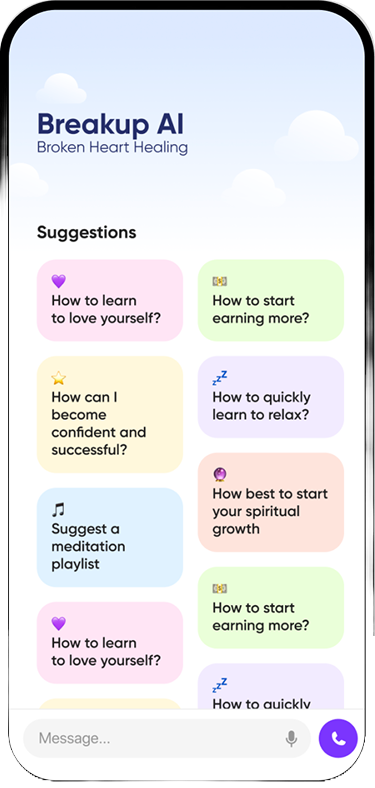
We build Breakup AI: No Contact Coach, so here’s exactly what it does, without exaggeration. It has a No Contact counter that tracks days since your last contact and marks milestones. It has an SOS button for the moment you want to text your ex, which runs a quick calming flow. There’s an AI chat that’s calm and judgment-free and available 24/7, and an AI voice call if you’d rather talk than type. It includes short AI prompts and exercises, and home-screen widgets so your progress is visible. It’s a paid subscription with a free trial.
It is not a therapist, and it isn’t designed for crises. If you’re in danger, call or text 988 in the US.
Want a coach for the moment you’re about to text them? Open the SOS button in Breakup AI before you type anything. It walks you through the next few minutes and counts your no-contact days.


How to get the most out of an AI breakup coach
- Use it at the peak, not after. Open it when you feel the urge, before you open your ex’s chat.
- Be specific. “I want to text him ‘I miss you’ because I just saw his story” gets a more useful reply than “I’m sad.”
- Ask it to challenge you. Try: “Be honest with me, not just supportive. Is this a good idea?”
- Don’t ask it to read your ex’s mind. “Does she still love me?” can’t be answered from your screenshots.
- Keep humans in the loop. If you’ve talked to an AI every night for a week and to no person, that’s a cue to call someone.
- Notice when you need more. If you’re not sleeping, eating or functioning, or feel hopeless, see a doctor or therapist.
Try this tonight: a 5-minute urge test with any AI coach.
- Next time you want to contact your ex, rate the urge from 1 to 10.
- Before touching their chat, open your coach and type exactly what you want to send and why.
- Ask: “What’s likely to happen if I send this, and what’s one thing I could do instead for the next 10 minutes?”
- Do that thing. Then rate the urge again. Notice the drop.
Is it weird to use AI to get over a breakup?
No more than journaling, reading self-help books, or calling a helpline. People have always looked for tools that help at the hours when nobody else is around. What matters is how you use it: as a bridge back to your own life and your people, not as a replacement for them. If you want a deeper look at the safety question, read is an AI therapist safe for a breakup?
FAQ
What is an AI breakup coach?
It’s an app or chatbot designed to support you through a breakup, usually with 24/7 chat, help resisting the urge to contact your ex, no-contact tracking and short exercises. It’s a support tool, not therapy.
Can an AI help me get over my ex?
It can help with specific things: interrupting urges to text, giving you somewhere to vent at night, and guiding exercises. Recovery still comes from time, distance, people and rebuilding your life. AI works best as one support among several.
Is an AI breakup coach the same as a therapist?
No. An AI coach can’t diagnose or treat mental health conditions and isn’t a licensed professional. If you’re dealing with depression, anxiety, trauma or self-harm thoughts, see a qualified therapist, and in a crisis call or text 988 in the US.
Are AI breakup apps safe?
Many can be used safely for support, but check that the app is clear about being AI, points to crisis resources, doesn’t encourage contacting your ex, and has a clear privacy policy. Don’t rely on any app in an emergency.
Is my data private in an AI breakup app?
It depends on the app. Read its privacy policy to see what’s stored, whether you can delete conversations, and whether data is shared. Conversations with AI apps generally don’t have the legal confidentiality of therapy.
What’s the difference between an AI breakup coach and ChatGPT?
General chatbots answer anything and may help you draft messages to your ex. A breakup coach is designed around breakup recovery, with features like urge interruption and no-contact counters, and its guidance is shaped to support distance from your ex.