
Short answer: You can’t stop thinking about your ex because heartbreak activates the brain’s craving and attachment systems, and every reminder, replay or “what if” keeps them switched on. Trying to force the thoughts away usually makes them louder. What works better is cutting the reminders, noticing and labelling the thoughts without arguing with them, giving rumination a set time and place, and filling the space with people, movement and new experiences.
You’re in the shower, at your desk, in line for coffee, and there they are again. A memory of their laugh. The last fight on loop. A full imaginary conversation where you finally say the right thing. You try to think about anything else, and somehow your brain finds its way back in under a minute.
It’s exhausting, and it can make you feel like something’s wrong with you. Nothing is. Here’s why it happens, and what actually helps.
Why your brain won’t let them go
Love works like a craving
When Helen Fisher and colleagues scanned the brains of people who’d recently been rejected while they looked at photos of their ex (Fisher et al. 2010, Journal of Neurophysiology), regions tied to reward, motivation and craving were active, the same broad systems involved in addiction. Constant thoughts about your ex are partly your brain chasing something it’s used to getting. Our explainer on the psychology behind no contact goes deeper into this.
Trying not to think about them backfires
In Daniel Wegner’s famous “white bear” experiments (Wegner et al. 1987, Journal of Personality and Social Psychology), people told not to think about a white bear ended up thinking about it more once they were allowed to. Wegner and Gold (1995) later explored the same kind of suppression with thoughts about a past relationship. Telling yourself “stop thinking about them” is like telling yourself not to notice your tongue in your mouth.
Rumination feels like problem solving, but isn’t
Replaying the breakup feels productive, as if you’ll finally find the answer that makes it make sense. Psychologist Susan Nolen-Hoeksema’s research on rumination found that repetitively dwelling on distress and its causes tends to deepen and prolong low mood rather than resolve it. You’re not solving the problem; you’re rehearsing it.
They were woven into your identity
After a breakup, people’s sense of who they are tends to get blurrier, and that loss is linked to more distress (Slotter, Gardner & Finkel 2010, Personality and Social Psychology Bulletin). If your routines, plans and even your sense of humour were shared, almost everything can remind you of them, simply because they were part of almost everything.
What kind of thoughts are you having?
Different thoughts need different responses. Figure out which ones show up most for you.
| Type of thought | Sounds like | What helps most |
|---|---|---|
| Replay | “If I hadn’t said that in the car…” | Worry time and labelling (below) |
| Fantasy future | “Maybe in a year we’ll run into each other and…” | Reality check: list why it ended |
| Self-blame | “I ruined it. I’m too much.” | Self-distanced talk, a friend’s perspective |
| Jealousy and comparison | “Are they with someone? Are they happier?” | Cut social media, stop asking friends |
| Unanswered questions | “Why did they really leave?” | Write the answers you have; accept the gaps |
| Random memories | A smell, a song, a street | Let them pass; they fade with time and distance |
8 things that actually help
1. Turn off the supply
Every time you check their profile, reread old texts or ask a mutual friend how they’re doing, you hand your brain a fresh dose of them. That reliably restarts the thought loop. Mute or block, archive the chat, and put photos in a hidden folder for now. If checking their socials is a big part of it, our guide on how to stop checking your ex’s Instagram has a step-by-step plan.
2. Label the thought instead of fighting it
When a thought about them shows up, give it a name: “There’s the replay again.” “That’s the fantasy.” Then gently go back to what you were doing. You’re not trying to make the thought disappear; you’re refusing to follow it down the rabbit hole. This idea, sometimes called cognitive defusion in acceptance and commitment therapy, shrinks a thought from “the truth” to “a thing my mind is doing.”
3. Give rumination an appointment
This one sounds strange and works surprisingly well. Pick a 15 to 20 minute window each day, same time, same place (not in bed). When thoughts about your ex come up during the day, jot a word in a note and tell yourself, “Not now, at 6pm.” Then, at 6pm, sit down and think, write or cry about it as much as you want until the timer ends. Researchers like Thomas Borkovec tested this kind of “worry postponement” for chronic worry back in 1983, and it remains a standard technique in therapy for anxious thinking.
4. Talk to yourself like an outsider
Ethan Kross and colleagues (2014, Journal of Personality and Social Psychology) found that reflecting on a stressful situation using your own name or “you” instead of “I” helped people handle it with less distress. Try it: “Okay, Sam. You’re missing them because it’s Sunday and Sundays were your day. That makes sense. What do you need right now?” It sounds silly in your head. It works because it gives you a little distance from the storm.
5. Use the reality list when you’re romanticising
When your mind serves up a highlight reel, it helps to remember the full picture. In a 2018 study in the Journal of Experimental Psychology: General, Sandra Langeslag and Michelle Sanchez found that thinking about an ex’s negative traits reduced love feelings for them, though it didn’t lift mood in the moment. Write a short, specific list: “They forgot my birthday.” “I always had to plan everything.” “I felt anxious every time they went quiet.” Read it when the fantasy starts.
6. Use distraction when you just need relief
The same study found distraction improved mood, even though it didn’t change love feelings. So distraction isn’t avoidance; it’s a legitimate tool for bad evenings. The best distractions use your hands or your body and pull your attention fully: cooking something new, a workout class, a hard puzzle, a phone call with someone who talks a lot.
7. Write it out with an ending
Structured writing can help turn the endless loop into a story with a beginning, middle and end. Our guide to the unsent letter method shows you how to do this without falling into a nightly rereading habit.
8. Grow your world back
Your brain thinks about your ex partly because there’s a big empty space where they used to be. Fill it. Plan things with friends, say yes to invitations you’d normally skip, start something you always meant to try. New experiences give your mind fresh material that has nothing to do with them.
Try this tonight: Make a note on your phone called “Parking lot.” Every time a thought about your ex pops up between now and tomorrow evening, type one or two words into it (“car fight,” “Lisbon trip”) and say “later.” Tomorrow at a set time, give yourself 15 minutes with the list. Most people find half the items feel much smaller by the time they get to them.
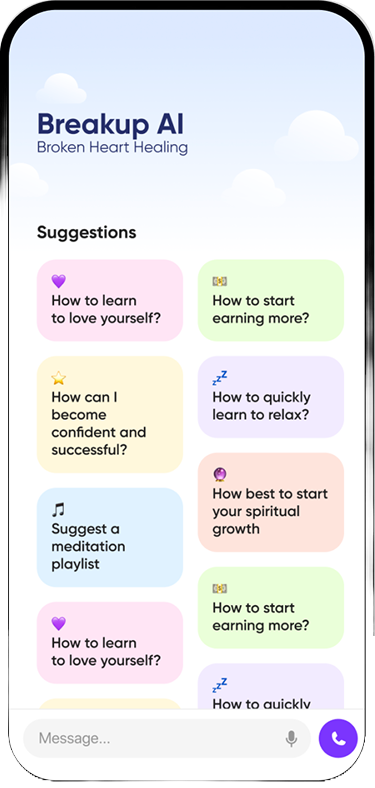
Thinking about them so much you want to text them? Open the SOS button in Breakup AI before you type anything. It walks you through the next few minutes and counts your no-contact days.


“If I think about them this much, doesn’t it mean we’re meant to be?”
It’s a very common belief and an understandable one. But how often you think about someone mostly reflects how attached you were, how suddenly it ended and how many reminders are around you. It’s what a grieving brain does, not a message from fate. People think obsessively about exes who treated them badly, too. The intensity tells you about your attachment, not about whether the relationship was right.
If what’s really driving the loop is a lack of answers about why it ended, our guide on dealing with a breakup with no closure may help.
Times of day when it’s worst
- First thing in the morning: the moment you remember. Get up quickly, open the curtains and put something on (a podcast, music) before your mind starts the replay.
- Commutes and showers: autopilot time. Give your brain a job: an audiobook, a call, a playlist they never heard.
- Weekends: unstructured time is when the empty space feels biggest. Plan at least one thing each day.
- Late at night: tiredness lowers your defences. Keep your phone away from the bed and have a wind-down routine you actually like.
How long will this last?
Intrusive thoughts are usually most intense in the first weeks, especially if contact continues. With real distance, most people notice the thoughts come less often and feel less sharp over the following months. You’ll know you’re getting there when a thought about them shows up and you notice it, feel a small pang, and carry on with your day. For a fuller picture, see how long it takes to get over a breakup.
If the thoughts are so constant that you can’t work, sleep or eat, if they come with intense anxiety or compulsions to check, or if you feel hopeless, it’s worth talking to a therapist or doctor. And if you ever feel unsafe or think about hurting yourself, call or text 988 in the US.
FAQ
Why can’t I stop thinking about my ex?
Heartbreak activates the brain’s reward and craving systems, so your mind keeps pulling you back toward them. Reminders, social media, rumination and trying to suppress the thoughts all keep that loop going. It’s a normal response to loss, not a sign something is wrong with you.
Is it normal to think about my ex every day?
Yes, especially in the first weeks and months after a breakup. Most people find the thoughts gradually become less frequent and less painful, particularly once they stop having contact and checking their ex’s social media.
Does thinking about my ex mean I still love them?
Not necessarily. Constant thoughts can come from attachment, habit, unanswered questions, loneliness or wounded pride as much as love. Even if you do still love them, that alone doesn’t mean the relationship was right or should restart.
How do I stop obsessing over my ex?
Cut reminders and contact, label the thoughts instead of fighting them, set a daily 15-minute window for thinking about the breakup, keep a realistic list of why it ended, and fill your time with people and new experiences. Trying to force the thoughts away usually makes them stronger.
Does my ex think about me as much as I think about them?
There’s no way to know, and it varies a lot. People who ended a relationship often grieved before the breakup, so they may think about it less now. Focusing on their thoughts keeps you stuck; focusing on your own healing moves you forward.
When should I get help for thinking about my ex?
If the thoughts stop you from working, sleeping or eating for weeks, come with intense anxiety or compulsive checking, or you feel hopeless, talk to a therapist or doctor. If you ever have thoughts of harming yourself, call or text 988 in the US.