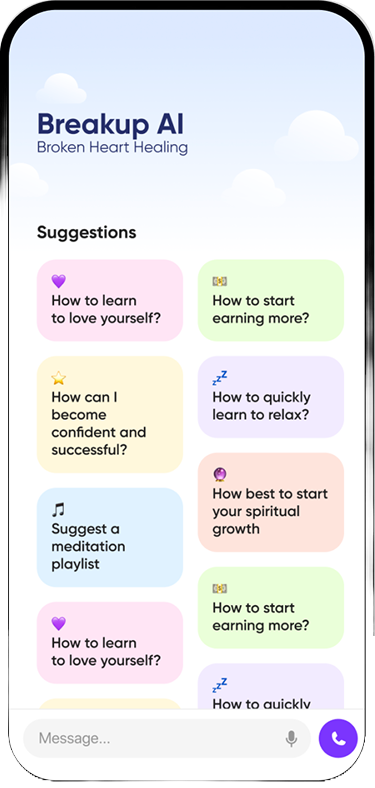

Short answer: You can get closure after a breakup without your ex. Closure is not an explanation they give you; it is the point where you accept that the relationship is over and stop needing the “why” answered. You build it by writing your own version of the story, accepting that some questions won’t be answered, saying goodbye in a ritual that doesn’t need their participation, and cutting the contact that keeps the questions open.
Maybe they ghosted. Maybe they ended it in a two-line text. Maybe you had “the talk” and it still made no sense, or they blamed you for something that didn’t add up. Either way, you are left holding a question that loops at 2 a.m.: why? And the urge to text them, just once, to ask.
Here is the uncomfortable truth: the closure conversation you are imagining rarely happens the way you want, and when it does, it often doesn’t give you the peace you hoped for. The good news is that closure is mostly an inside job, and you can start it tonight.
Why no closure hurts so much
Your brain hates open loops
Psychologists have long noted that unfinished tasks tend to stay more active in memory than finished ones, an idea associated with Bluma Zeigarnik’s work in the 1920s. A relationship that ended without explanation is the ultimate unfinished task. Your mind keeps returning to it, trying to complete it.
Social psychologist Arie Kruglanski studied what he called the “need for cognitive closure,” the desire for a firm answer rather than ambiguity. People differ in how strong this need is. If you’re high on it, a breakup without clear reasons can feel especially unbearable.
It’s an ambiguous loss
Pauline Boss’s concept of “ambiguous loss” describes losses without clear boundaries or endings. A ghosting, a slow fade, or an “I just need space” that never resolves all fit. Without a clear ending, it’s hard to start grieving properly, because part of you is still waiting.
You’re still craving them
Fisher et al. (2010, Journal of Neurophysiology) showed that people recently rejected by a partner still showed activity in reward and craving systems when they saw the person. The “I just need closure” urge is often part craving in disguise. You want answers, yes. You also want contact.
Why the closure conversation usually disappoints
Here’s what often happens when people get the talk they asked for:
- They give a vague answer. “I just wasn’t feeling it.” Now you have more questions.
- They give a specific answer that hurts. You replay it for months.
- They’re kind and warm. Hope comes back, and with it the craving.
- They rewrite history. You leave angrier and more confused.
- It turns into hooking up or “let’s be friends.” And you’re back to square one.
Often the person who left doesn’t fully understand why themselves. Feelings change in ways that are hard to explain even from the inside. You may be asking for an answer that doesn’t exist in a form that would satisfy you.
Common “closure” texts, and what they’re really asking
| The text you want to send | What you’re really hoping for | What usually happens |
|---|---|---|
| “I just need to understand why.” | An answer that makes the pain make sense | A vague reply, or none |
| “Did any of it mean anything to you?” | Reassurance you mattered | “Of course it did,” which reopens hope |
| “Can we meet up and talk properly?” | A chance to fix it | An awkward meeting or a firmer rejection |
| “I’m not mad, I just want closure.” | Contact without looking needy | They sense the hope and pull back |
| “I hope you’re happy with her.” | To show your hurt, and to see if they react | Regret by morning |
If you have a genuinely practical need (belongings, money, shared lease, kids), communicate about that only, briefly. If you’re torn about reaching out at all, our should I text my ex decision guide walks through it.
How to get closure without your ex
1. Write your own account of what happened
Write the story of the relationship from beginning to end, as honestly as you can: how it started, the good parts, when things shifted, how it ended. Then write the best explanation you can come up with for why it ended. Not the most self-blaming one, the most likely one. You might include a few possibilities: “they weren’t ready,” “we wanted different things,” “they checked out months ago.”
You won’t know which is true. That’s okay. A good-enough story lets your mind put the file away.
One caution: research on people going through marital separation (Sbarra et al. 2013, Clinical Psychological Science) found that unstructured, emotionally intense expressive writing actually slowed recovery for people who tended to ruminate heavily. Keep this exercise structured, time-limited, and aimed at making sense of things, not reliving every painful moment. If writing makes you spiral, stop and talk to a friend instead.
2. Accept the unanswerable questions
Make a list of the questions you’d ask them. Then next to each, write: “I may never know this.” Read it out loud. It’s painful but freeing. Acceptance doesn’t mean you’re fine with it. It means you stop fighting the fact that this is how it is.
3. Write the unsent letter
Write everything you’d say if you knew there were no consequences: anger, love, questions, goodbye. Don’t send it. The point is to let it out of your body and onto the page. We explain the full method in the unsent letter to your ex.
4. Create an ending ritual
Without a goodbye conversation, there’s no “moment” where it ended. Create one. Some ideas people find helpful:
- Box up their things and take them to a donation shop or drop them back with a friend.
- Read your unsent letter aloud once, then delete or shred it.
- Delete the chat thread (or archive it into a folder you won’t open).
- Go somewhere meaningful alone, say “goodbye” out loud, and leave.
- Write a final line in your notes app with the date: “This is where I let it go.”
5. Stop reopening the loop
Closure can’t hold while you’re checking their profile or waiting for a reply. Each check reopens the question. Stick to no contact for at least a few weeks and mute or block wherever it’s easier.
Want to send the “I just need closure” text? Open the SOS button in Breakup AI before you type anything. It walks you through the next few minutes and counts your no-contact days.


6. Look at how they ended it as information
How someone ends a relationship tells you something about them. Ghosting, blaming, vague exits and cruelty are signs of how they handle hard moments. You don’t need a full explanation to notice that.
7. Focus on forward questions
Replace “why did they leave?” with questions you can actually answer:
- “What do I want in my next relationship that I didn’t have?”
- “What did I learn about my boundaries?”
- “What do I want my life to look like in six months?”
Try this tonight: close the loop in 20 minutes.
- Write the three questions you most want them to answer.
- Under each, write your best honest guess.
- Under each guess, write “I may never know, and I can still move on.”
- Write one sentence: “The relationship ended on [date]. It’s over, and I’m allowed to stop waiting.”
- Close the notebook. Put your phone in another room for the rest of the night.
Situations where closure is extra hard
You were ghosted. Being ghosted can feel like being erased. The silence is the answer, even if it’s a cowardly one. If they’ve blocked you as well, see what to do when your ex blocked you.
They moved on right away. A new partner within weeks can make you question the whole relationship. It usually says more about how they cope than about what you shared.
They keep coming back. Breadcrumbing (occasional texts, likes, “hey stranger”) keeps closure impossible. Decide in advance not to respond to anything that isn’t a clear, serious conversation, and even then, think carefully.
You can’t avoid them. Same workplace, same friend group, shared kids. Closure here is about emotional distance, not physical. Keep contact polite, brief and practical, and do your processing elsewhere.
When to get help
If months later you’re still consumed by the “why,” if it’s affecting your sleep, work or other relationships, or if you feel hopeless, consider talking to a therapist. They can help you work through the loop. If you have thoughts of harming yourself, in the US call or text 988; in the UK call Samaritans on 116 123.
FAQ
Can you get closure without talking to your ex?
Yes. Closure is about accepting the relationship is over, not getting a perfect explanation. Writing your own account, accepting unanswered questions, an ending ritual and no contact can all give you closure without them.
Should I ask my ex for closure?
Usually it doesn’t give the peace you want. Answers tend to be vague, painful or hope-reviving. If you’ve never had any conversation at all, one calm talk can help, but don’t keep asking.
Why do I need closure so badly?
Your mind keeps returning to unfinished situations, and some people have a stronger need for clear answers than others. The urge for closure can also be a disguised craving for contact with your ex.
How do I get closure after being ghosted?
Treat the silence as the answer, write your best explanation of what happened, create your own ending ritual, and stop checking their profiles. Ghosting reflects their avoidance, not your worth.
How long does it take to find closure after a breakup?
It varies, but closure usually builds gradually over weeks or months as contact stops and you make your own meaning of what happened. It often arrives quietly, when you realize the “why” doesn’t burn anymore.