
Short answer: To get over a breakup, first stop the contact and the checking so the wound can close, then get your body through the first weeks with sleep, food, movement and people, and finally rebuild the parts of your identity that got folded into the relationship. Recovery isn’t a straight line, but most people feel noticeably better within a few months when they stop feeding the craving and start feeding their own life.
Nobody tells you how physical a breakup is. The tight chest when you wake up. Forgetting for three seconds, then remembering. Reaching for your phone to tell them something funny and then realizing you can’t. If that’s where you are, this guide is built for you: what to do today, this week and this month, in that order.
Why breakups hurt so much
It helps to know what you are up against. When researchers scanned people who had just been rejected by a partner, the brain areas involved in reward and craving were highly active (Fisher et al. 2010, Journal of Neurophysiology). Another study found that looking at an ex’s photo after an unwanted breakup activated regions that also process physical pain (Kross et al. 2011, PNAS). Your brain is not broken. It’s doing exactly what a brain does when something it relied on disappears.
There’s a second, quieter loss too. In a long relationship, “I” slowly becomes “we.” You share friends, routines, jokes and plans. Research by Erica Slotter, Wendi Gardner and Eli Finkel (2010, Personality and Social Psychology Bulletin) found that after a breakup, people often report a less clear sense of who they are, and that this confusion is linked to emotional distress. Part of getting over someone is getting back to yourself.
Step 1: The first 72 hours, just get through them
You don’t need to process anything yet. You need to survive the next three days without making things worse.
- Eat something, even if it’s toast. Grief kills appetite. Low blood sugar makes everything feel more desperate.
- Drink water, skip the heavy drinking. Alcohol is the number one cause of 2 a.m. texts you regret.
- Tell one person what happened. Saying it out loud makes it real, which hurts, but it also means you’re not carrying it alone.
- Don’t make big decisions. Don’t quit your job, move cities or post a long caption. Your judgment is temporarily offline.
- Let yourself cry. It isn’t weakness and it isn’t “not coping.” It’s the body releasing pressure.
Step 2: Stop the contact and the checking
This is the single most important step, and the one people most want to skip. Every message, call, story view or late-night scroll through old photos resets the craving. You get a small hit of connection, then the crash, and your brain learns to keep chasing.
That’s why the no contact rule is so widely recommended: a set period, usually at least 30 days, with no communication at all. If you share kids, a job or a home, you go to logistics-only contact instead.
The checking matters as much as the texting. Tara Marshall’s 2012 study in Cyberpsychology, Behavior, and Social Networking found that ongoing Facebook monitoring of an ex was linked to more distress and longing and less personal growth. Mute, unfollow, or block for now. Archive the chat so it isn’t the first thing you see. Move the photos into a hidden album. You’re not erasing the relationship. You’re taking it off the kitchen table.
The message you’re about to send
You probably have one drafted. Common versions:
- “Can we talk? I just need to understand.”
- “I’m not trying to get back together, I just miss you as a friend.”
- “Hope you’re okay. No need to reply.”
- “I think you have my hoodie.”
Each of these looks reasonable. Each one is really asking for reassurance. Before you send anything, ask yourself what reply you’re hoping for and how you’ll feel if it doesn’t come. If the honest answer frightens you, write it in your notes app instead.
Try this tonight: name it, then shrink it. When a wave hits, say out loud or write: “I’m feeling ___ and I want to ___.” For example: “I’m feeling panicky and I want to check their Instagram.” Putting feelings into words reduces their intensity; Matthew Lieberman’s team at UCLA showed this “affect labeling” calms activity in the brain’s threat response (Lieberman et al. 2007, Psychological Science). Then ask yourself what the smallest helpful thing is for the next ten minutes. Not the next month. Ten minutes.
Step 3: Look after your body for the next two weeks
Heartbreak runs through the body: sleep, appetite, heart rate, stomach. You’ll think more clearly if you treat the first fortnight like recovering from flu.
| What feels like it helps | What actually helps |
|---|---|
| Scrolling until 3 a.m. | A fixed bedtime, phone charging outside the bedroom |
| Drinking to numb it | Seeing friends somewhere that isn’t a bar |
| Rereading old messages for clues | Writing what you actually feel in a journal |
| Staying in bed all weekend | A 20-minute walk outside, every day, no matter what |
| Asking mutual friends about them | Asking friends about their own lives |
| Rebound dating to prove you’re fine | Doing one thing a day that’s just for you |
Exercise is not a cure, but it’s one of the most reliable mood lifts available, and it gives your restless energy somewhere to go. Sleep is harder. If you’re lying awake replaying conversations, our guide on what to do when you can’t sleep after a breakup has practical routines that don’t involve your phone.
Step 4: Make sense of what happened, without obsessing
At some point your brain will want a story: why it ended, what went wrong, whose fault it was. That’s healthy. What isn’t healthy is replaying the same three conversations hoping for a different answer.
Writing helps you find the story and then put it down. Researchers Grace Larson and David Sbarra (2015, Social Psychological and Personality Science) found that people who repeatedly reflected on their breakup as part of a study recovered a clearer sense of who they were, and that this was linked to feeling less lonely and less upset. You don’t need a study to do it. Try these prompts, one per evening:
- What did I love about this relationship, honestly?
- What did I quietly put up with?
- What did I stop doing while I was with them?
- What would I tell a friend who described this exact relationship to me?
- What do I want to be different next time?
If there’s something you need to say to them, write it all out without sending it. The unsent letter method gives the words somewhere to go.
The “remember the bad stuff” trick, and its trade-off
Sandra Langeslag and Michelle Sanchez (2018, Journal of Experimental Psychology: General) tested ways of dialing down love feelings after a breakup. Deliberately thinking about an ex’s negative traits reduced how in love people felt, but it also made them feel worse in the moment. Distraction lifted mood without reducing the love. The takeaway: a short, honest list of the things that didn’t work can help loosen the pull, but pair it with things that make you feel good. Don’t live in the list.
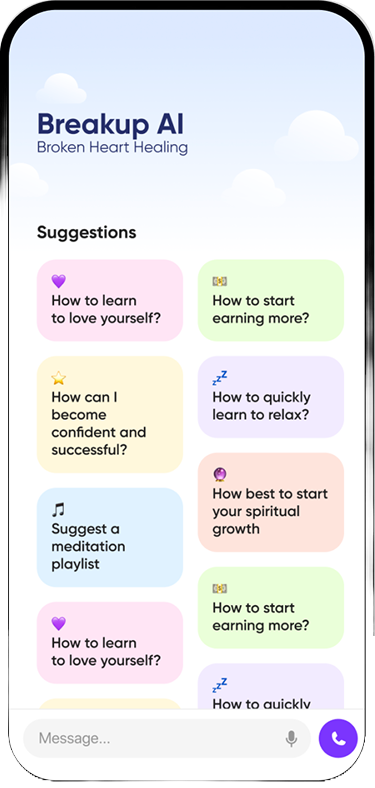
Mind racing about them right now? Open Breakup AI and talk it through in the AI chat or a calming voice session, any hour. When the urge to text hits, the SOS button walks you through the next few minutes and counts your no-contact days.


Step 5: Rebuild the “you” that got lost
This is the stage where things start to feel different. Not fixed, but different. A few concrete ways in:
- Reclaim one thing you dropped. The band they thought was cringe. The friend you stopped seeing. The hobby you never had time for. Do it this week.
- Change one space. Move the bed, swap the sheets, rearrange the sofa. Your home has a thousand small reminders, and changing the layout quietly retrains your brain.
- Make new memories in old places. The café you always went to together doesn’t have to be off limits forever. Go with a friend and make it about something else.
- Set one small goal with a date. A 5k in eight weeks, a short course, a trip. Something to aim at that’s yours.
There’s real evidence that growth after a breakup is common. Ty Tashiro and Patricia Frazier (2003, Personal Relationships) found that people reported an average of five positive changes after a breakup, such as feeling more confident, more independent and clearer on what they want. In a 2007 study by Gary Lewandowski and Nicole Bizzoco (The Journal of Positive Psychology), 71% of participants reported high personal growth after a recent breakup. Pain and growth can sit side by side.
How long will this take?
Honestly, it depends: how long you were together, whether you saw it coming, whether you’re still in contact, and how much support you have. Most people notice the worst of it lifting over weeks to a few months, with setbacks on anniversaries, birthdays and random Tuesdays when a song comes on. Our breakup recovery timeline breaks down what’s typical week by week, so you can see that the bad day you’re having is normal and not a sign you’re going backwards.
When to get extra help
Heartbreak is normal pain. But sometimes it slides into something heavier. Talk to a doctor or therapist if, for more than a couple of weeks, you can’t get out of bed, can’t eat, can’t work, or feel hopeless most of the time. If you ever have thoughts of hurting yourself, please reach out now: in the US, call or text 988; in the UK, call Samaritans on 116 123. Needing help isn’t failing at getting over someone. It’s how a lot of people get there.
Signs you’re getting over it
You’ll notice it in small ways before you feel it in big ones. You forget to check their profile for a day. You hear their name and your stomach doesn’t drop. You catch yourself laughing at something and feel guilty for a second, then don’t. You start thinking about the future without them in it, and it’s not entirely scary. That’s when it’s worth thinking about when to start dating again, if you want to. There’s no deadline.
FAQ
What is the fastest way to get over a breakup?
There’s no shortcut, but the things that speed recovery are consistent: stop contact and social media checking, keep up sleep, food and exercise, lean on friends, and spend time on activities that are yours alone. The fastest way to slow recovery is staying in touch and hoping.
How long does it take to get over a breakup?
It varies widely. Many people feel significantly better within a few months, though longer relationships, sudden breakups and ongoing contact usually stretch it out. Expect good days and bad days rather than a steady line.
Is it normal to still love my ex?
Yes. Love doesn’t switch off when a relationship ends. You can love someone and still know the relationship wasn’t right. The feeling fades as you stop feeding it with contact and checking.
Should I stay friends with my ex?
Not right away. Trying to be friends while you still have feelings usually keeps you hooked. Take a proper break first. Once you feel neutral, you can decide whether a friendship is something you actually want.
Why do I feel worse weeks after the breakup?
The first days are often fueled by adrenaline and shock. Once that wears off and friends stop checking in, the loss can feel heavier. This is a common pattern and not a sign you’re failing. It usually eases with time and support.
Does a rebound help you get over someone?
Sometimes a rebound feels good for a while, but using a new person to avoid feelings tends to delay them. If you date, be honest with yourself and the other person about where you are.