
Short answer: A good breakup self-care plan for the first week covers five basics every day: sleep at regular times, eat something real three times, move your body for 10-20 minutes, talk to at least one person, and protect yourself from your phone (no checking their profiles, no late-night texts). Keep the bar low and specific. In week one, self-care is not bubble baths; it is keeping your body and routine stable while the shock wears off.
The first week after a breakup is a strange place. Time is slow and fast at once. You might feel numb on Monday and flattened on Wednesday. You probably do not have the energy for a “glow-up,” and you should not need one. What you need is a simple plan that keeps you fed, rested, connected and away from the moves that make it worse.
This is that plan: a day-by-day first week, a daily checklist you can screenshot, and what to do when the plan falls apart (it will, a bit, and that’s fine).
Why week one needs a plan
Right after a breakup your stress response is high, your sleep and appetite are off, and your brain is craving contact with the person you just lost. Brain-imaging work on people recently rejected in love (Fisher et al. 2010, Journal of Neurophysiology) found activity in reward and craving systems, which is part of why the urge to check on them can feel so strong. Decision-making under that kind of stress is poor. A plan you made in a calmer moment does the thinking for you when you cannot.
The plan also stops the two most common week-one traps: total collapse (bed, phone, no food, no people) and frantic overcorrection (going out every night, drinking, swiping on dating apps by day three). Both delay the actual recovery.
The five daily non-negotiables
Before the day-by-day, here are the five things to aim for every single day of week one. If you only do these, you are doing well.
| Basic | Minimum version | Why it matters |
|---|---|---|
| Sleep | Same wake-up time daily, phone out of bed | Poor sleep makes the next day more emotional and impulsive |
| Food | Three small meals, even if it’s toast, soup or a smoothie | Stress kills appetite; low blood sugar amplifies anxiety |
| Movement | A 10-20 minute walk, ideally outside in daylight | Burns off stress hormones and resets your mood a little |
| People | One real conversation (call, voice note, or in person) | Social support buffers stress and helps crying feel like release |
| Phone boundaries | No checking their profiles, no texting them after 9 p.m. | Each check or text restarts the craving and the hurt |
Your first week after a breakup, day by day
Day 1: Survive and tell someone
Do not try to process anything. Today is for getting through.
- Tell one or two trusted people what happened. A simple text works: “We broke up. I’m okay-ish but I’d like company this week.”
- Eat something and drink water, even if you are not hungry.
- Cry if you need to. It is not a setback.
- If you can, mute their notifications so their name does not pop up unexpectedly.
Our guide to the first day of no contact covers the hour-by-hour of this day in more detail.
Day 2: Clear the immediate triggers
- Archive the chat thread. Turn off photo “memories.”
- Mute, unfollow, or block on social media. You do not need to decide forever; you are deciding for this week. If you are torn, read whether to unfollow, mute or block.
- Put their things in a box and put it somewhere you won’t see daily.
- Write down three people you can call at night if it gets bad.
Day 3: Rebuild a skeleton routine
Day three is often harder than day one, because the adrenaline wears off and reality sets in. This is where routine earns its keep.
- Set a fixed wake time and a “phone down” time for tonight.
- Plan meals for the next two days. Order groceries if cooking feels impossible.
- Get outside before noon, even for 10 minutes.
Day 4: Handle the practical stuff
If you have shared things to deal with (keys, belongings, a lease, a pet, subscriptions), list them now. Do not try to resolve everything today. Pick one, and keep any communication short and businesslike: “Hi, can I collect my things on Saturday between 10 and 12? I’ll bring the spare key.” No emotional paragraphs. If you live together or share kids, see our guides for living or working together.
Day 5: Let yourself feel it, on purpose
Give your feelings a scheduled slot: 20 minutes in the evening to write, cry, or talk. Write freely about what you miss, what hurt, what you’re angry about. Then close the notebook and do something with your hands. Some research suggests that open-ended venting about a separation can backfire for heavy ruminators (Sbarra et al. 2013, Clinical Psychological Science), so keep it time-limited and end with something forward-looking, like one thing you’ll do tomorrow.
Day 6: Do one thing that’s yours
Pick an activity that has nothing to do with them. A swim, a class, a long walk in a part of town you don’t usually go to, cooking a recipe they hated. It does not have to be fun. It has to be yours. Research on self-concept after breakups (Slotter, Gardner and Finkel 2010, Personality and Social Psychology Bulletin) found that people often feel less sure who they are after a breakup, and that this confusion is linked to distress. Small acts of “this is me” help rebuild that.
Day 7: Review and plan week two
- Look back: what helped? What made it worse? (Most people find late-night scrolling and alcohol are top of the “worse” list.)
- Plan two social things for next week.
- Decide your rule for contact: how long will you hold no contact before you reassess?
- Notice anything you did well. You got through a week. That counts.
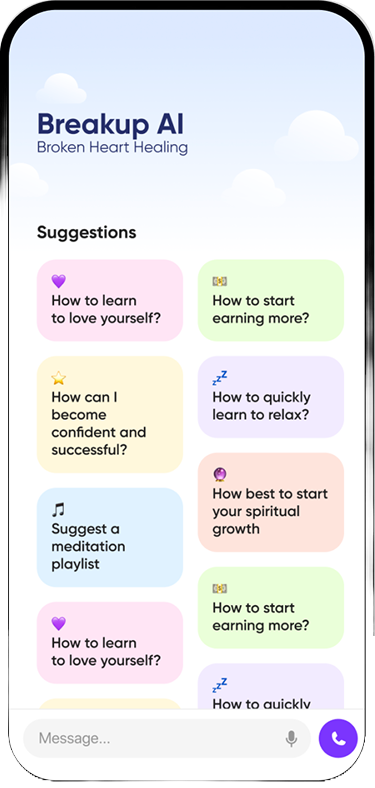
Want a plan that stays with you at 2 a.m.? Open the SOS button in Breakup AI before you type anything. It walks you through the next few minutes and counts your no-contact days.


The things to avoid in week one
None of these make you a bad person. They just tend to make the week longer.
- Texting them “just to talk.” The “I just want closure” message, the “hope you’re okay” message, the “you left your charger” message that is not about the charger. If you genuinely need to communicate about logistics, keep it to one line.
- Drinking to sleep. Alcohol may knock you out, but it tends to wreck the second half of the night and makes 3 a.m. texting far more likely.
- Investigating. Checking who they follow, who liked their post, what their friends are posting. It feels like information; it works like a drug.
- Making big decisions. Quitting your job, moving cities, cutting off friends who know them, getting a dramatic haircut at midnight. Wait at least a few weeks.
- Rushing onto dating apps. Some people do fine dating soon after a breakup, but in week one it is usually about soothing, not connecting.
When the plan falls apart
You will have a bad day. You might skip meals, stay in bed, or look at their Instagram for an hour. That does not cancel the plan. Self-care is not a streak you can break; it is something you come back to.
Research on people going through separation (Sbarra, Smith and Mehl 2012, Psychological Science) found that those who related to their experience with more self-compassion had less emotional distress over the following months. Practically, that sounds like: “Okay, today went badly. That’s what heartbreak does. What’s the smallest thing I can do now?” Then do it. A glass of water counts.
Try this tonight: make your one-page week-one plan.
- On a piece of paper or notes app, write five headings: Sleep, Food, Move, People, Phone.
- Under each, write the smallest version you can do tomorrow (for example “wake at 7:30,” “eggs on toast,” “walk to the shop,” “call Sam,” “phone in kitchen at 10”).
- Add one line at the bottom: “If I want to text them, I will…” and pick an action (call a friend, open the SOS flow, go outside for 5 minutes).
- Screenshot it and set it as your lock screen for the week.
Self-care ideas that actually help (and cost nothing)
- Change your sheets and open the windows. A reset room feels different.
- Make a playlist that is not sad and not about them.
- Write a list of what you will not miss. Read it when you are romanticizing.
- Shower and get dressed even if you’re staying home.
- Ask a friend to hold your phone on a night out.
- Go to bed with an audiobook or podcast instead of your feed.
- Do one five-minute tidy a day, so your space isn’t adding to the chaos.
When self-care is not enough
A self-care plan supports you. It does not replace professional help if you need it. Reach out to a doctor, therapist or counselor if you cannot eat or sleep for several days, if you cannot function at work or school, or if the sadness feels like hopelessness about everything. If you have any thoughts of harming yourself, in the US call or text 988 right now; in the UK call Samaritans on 116 123.
Week one is the hardest stretch for many people. Get through it with the basics, and week two will have a little more room in it. For what comes next, see how to get over a breakup, step by step.
FAQ
What should I do the first week after a breakup?
Focus on basics: regular sleep, three small meals, a daily walk, one conversation with someone you trust, and strict phone boundaries around your ex. Avoid big decisions, heavy drinking and contacting your ex.
What is a breakup self-care routine?
It is a simple daily structure that keeps your body and mind stable after a breakup: a fixed wake-up time, meals, movement, time with people, a scheduled time to feel your feelings, and limits on checking your ex’s social media.
Is it okay to stay in bed after a breakup?
A day or two of rest is normal. If it stretches beyond that, try the smallest step out: sit up, open the curtains, eat something, step outside for five minutes. Long stretches in bed with your phone usually make you feel worse.
Should I go out a lot after a breakup?
Seeing people helps, but in the first week aim for calm company rather than big nights out. Heavy drinking and late nights often lead to texting your ex and worse days afterwards.
How do I take care of myself emotionally after a breakup?
Give your feelings a time-limited slot each day, talk to people you trust, speak to yourself with the same kindness you would offer a friend, and reduce reminders such as their social media. Get professional support if you feel hopeless or cannot function.