
Short answer: The psychology behind the no contact rule is mostly about how the brain learns and unlearns attachment. After a breakup, your brain’s reward and attachment systems keep craving your ex, much like a habit or withdrawal. Each text, reply or profile check feeds that craving on an unpredictable schedule, which makes it stronger. No contact removes the cues and rewards so the craving can gradually fade, and gives you room to rebuild a sense of self that isn’t organized around them.
No contact gets talked about as a rule, a tactic or a test of willpower. Underneath, it’s simpler than that. It’s a way of working with how your brain is wired instead of against it. Once you understand what’s going on in your head when you’re desperate to check their story, the rule stops feeling like an arbitrary punishment and starts making sense.
1. Your brain treats your ex like a reward it’s lost
When you fall for someone, your brain’s reward system learns that this person means pleasure, comfort and safety. When they leave, that learning doesn’t switch off. It goes looking for them.
Anthropologist Helen Fisher and colleagues scanned the brains of people who had recently been rejected by a partner but were still in love (Fisher et al. 2010, Journal of Neurophysiology). Looking at a photo of the ex activated regions associated with reward, motivation and craving, including areas also involved in addiction. In other words, the “I need to see what they’re doing” feeling has a biological basis. It’s not weakness. It’s a brain trying to get back something it learned to depend on.
This is the core reason no contact works. Cravings tied to a reward fade most reliably when the reward stops arriving.
2. Rejection really does hurt, physically
The pain is not a metaphor. In a 2011 study in PNAS, Ethan Kross and colleagues had people who had recently gone through an unwanted breakup look at photos of their ex. The brain regions that responded overlapped with regions that respond to physical pain. Earlier work by Naomi Eisenberger, Matthew Lieberman and Kipling Williams (2003, Science) showed that even being left out of a simple online ball-tossing game activated brain areas linked to the distress of physical pain.
Seeing their face, reading their messages or scrolling their photos re-triggers that pain. No contact reduces how often you’re exposed to it, which is one reason the ache often starts to dull within weeks. There’s more on the body side of this in why breakups hurt physically.
3. Unpredictable replies make the craving stronger
Here’s the mechanism most people don’t realize they’re caught in. When you text your ex, you don’t know what you’ll get. Sometimes a warm reply. Sometimes a cold one. Sometimes nothing for six hours, then a heart emoji. Behavioral psychology has a name for rewards that arrive unpredictably: intermittent reinforcement. Since B.F. Skinner’s experiments, it has been known as one of the most powerful ways to keep a behavior going, and it’s the logic behind slot machines.
That’s why you can know a conversation will hurt and still keep checking your phone. Each check is a pull on the lever. Staying in “friendly” contact, the occasional “hope you’re well,” the late-night “u up,” all keep the machine paying out just often enough. No contact takes the machine away.
4. Unlearning happens through extinction, and it’s bumpy
In learning theory, when a behavior stops being rewarded, it eventually fades. This is called extinction. But extinction has two features that explain why no contact feels so uneven:
- The urge often gets worse before it gets better. When a reward suddenly stops, behavior tends to spike briefly as the brain tries harder to get it back. Behaviorists call this an extinction burst. In breakup terms, it’s day 3 or day 10, when you suddenly feel you absolutely must message them. That spike is a sign the old pattern is losing, not winning.
- Old urges can come back out of nowhere. Weeks later, a song or a smell can bring the craving back at full strength for an hour. This is called spontaneous recovery. It doesn’t mean you’ve lost your progress. It usually passes faster each time.
If you know these two patterns are coming, they’re much less frightening when they arrive.
Try this tonight: surf the urge. When the craving hits, don’t fight it and don’t obey it. Set a timer for ten minutes. Notice where you feel the urge in your body: chest, stomach, hands. Rate it from 1 to 10. Every two minutes, rate it again. Breathe out slowly while you do. Most people find the number peaks and then drops on its own. This technique, often called urge surfing, comes from addiction research and is used in relapse-prevention programs. Each time you ride a wave out without acting, you’re teaching your brain that the craving doesn’t have to be obeyed. Our guide to the 90-second rule for cravings goes deeper.
5. Your attachment system is sounding an alarm
Attachment theory, which grew out of John Bowlby’s work, describes how humans react when separated from someone they’re bonded to. The typical response is protest: anxiety, searching and attempts to re-establish contact. In adults, it looks like checking, calling, waiting outside their work, or sending long messages at 2 a.m.
David Sbarra and Cindy Hazan (2008, Personality and Social Psychology Review) described how partners in a relationship help regulate each other’s stress and emotions. When the relationship ends, that co-regulation disappears, and people have to relearn how to calm themselves. That’s partly why the first weeks feel so destabilizing: you’ve lost your usual way of coming down from a bad day.
People with a more anxious attachment style often feel this alarm especially strongly. If that’s you, no contact may feel almost physically impossible at first. It’s not a character flaw. It’s an alarm system that’s turned up high, and it can learn to settle when it stops getting mixed signals.
6. Rumination keeps the wound open
Rumination is replaying the same thoughts over and over without getting anywhere: why did they leave, what if I’d said this, are they with someone now. The research of Susan Nolen-Hoeksema linked this kind of repetitive, passive brooding to longer and deeper low moods.
Contact is fuel for rumination. Every new message, story or update gives your brain fresh material to analyze. No contact doesn’t stop rumination on its own, but it stops adding to it. Pair it with tools that help you think differently, not just more. If the loop is constant, read what to do when you can’t stop thinking about your ex.
One technique with good evidence is self-distancing. Ethan Kross and Ozlem Ayduk’s research found that reflecting on painful experiences from a step back, for example asking “why is Sam feeling this way?” using your own name, helps people make sense of feelings with less distress than reliving them.
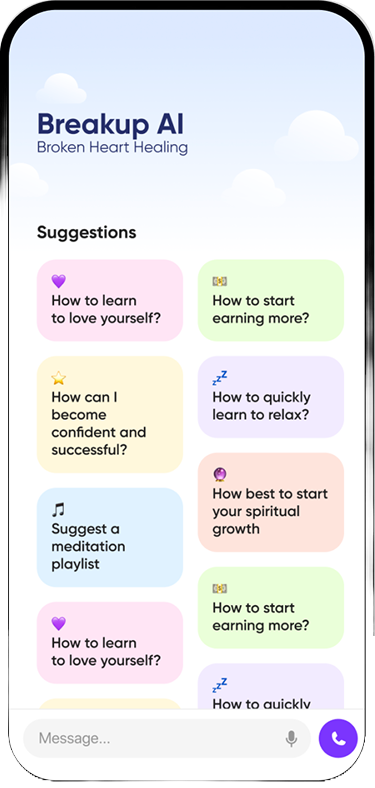
Feeling the pull right now? Open the SOS button in Breakup AI before you type anything. It walks you through the next few minutes and counts your no-contact days.


7. Social media is contact your brain can’t tell apart
Checking their profile feels harmless because they don’t know about it. Your brain doesn’t care. It gets the same cue, the same hit of hope or pain, and the same fresh material to ruminate on.
Tara Marshall’s 2012 study in Cyberpsychology, Behavior, and Social Networking found that people who continued to monitor an ex’s Facebook reported more distress over the breakup, more negative feelings, more longing for the ex and less personal growth than those who didn’t. That’s why a serious no-contact period includes muting or unfollowing. Here’s a practical plan to stop checking your ex’s Instagram.
8. Space lets you rebuild who you are
Long relationships merge identities. Your weekends, your friends, your music, even the way you see yourself get shaped by the “we.” Erica Slotter, Wendi Gardner and Eli Finkel (2010, Personality and Social Psychology Bulletin) found that after a breakup, people’s sense of self often becomes less clear, and that this “who am I without you” confusion is linked to emotional distress.
Grace Larson and David Sbarra (2015, Social Psychological and Personality Science) found that people who repeatedly reflected on their breakup regained self-concept clarity, and that this was associated with better recovery. Constant contact keeps you defining yourself in relation to them. No contact gives you room to answer the question on your own terms.
The mechanisms at a glance
| What’s happening | What it feels like | How no contact helps |
|---|---|---|
| Reward and craving systems active | Compulsion to check, text, see them | Removes the reward so cravings can fade |
| Pain-related brain activity | Physical ache, tight chest, nausea | Fewer triggers means fewer flare-ups |
| Intermittent reinforcement | Hooked on waiting for replies | No more unpredictable rewards |
| Extinction bursts and spontaneous recovery | Sudden spikes, surprise relapses | Knowing they pass makes them easier to ride out |
| Attachment alarm | Panic, protest, need for reassurance | Stops mixed signals so the system can settle |
| Rumination | Replaying the same thoughts | Stops adding new material |
| Lost sense of self | “Who am I without them?” | Room to rebuild independent identity |
What no contact is not
The psychology also explains what no contact shouldn’t be. It isn’t reverse psychology to make your ex miss you. When it’s used that way, you stay focused on them, checking for signs that it’s “working,” and the craving never gets the quiet it needs to fade. It isn’t punishment either. You can wish someone well and still not speak to them.
Think of it as removing the triggers while your brain recalibrates. If you want the practical how-to, our complete guide to the no contact rule covers what counts as contact, how to start and what to do when you slip.
And if the pain feels like more than heartbreak, if you feel hopeless most days for weeks or have thoughts of hurting yourself, please talk to someone. In the US, call or text 988. In the UK, call Samaritans on 116 123.
FAQ
Why is no contact so hard psychologically?
Because your brain’s reward and attachment systems are still wired to seek your ex. Cutting contact feels like withdrawal, with cravings, anxiety and urges that can briefly get stronger before they fade.
Why does the urge to text my ex get worse after a few days?
This is often an extinction burst: when a reward suddenly stops, the brain briefly pushes harder to get it back. It’s a common sign the old habit is weakening, not a sign you should give in.
Does no contact make your ex miss you?
It can, because absence removes the familiar presence and people sometimes reflect more when there’s space. But there’s no guarantee, and focusing on their reaction tends to keep you stuck. The reliable benefit of no contact is your own recovery.
Is checking my ex’s social media breaking no contact?
Technically, they don’t hear from you. Psychologically, it has similar effects: research links monitoring an ex online with more distress and longing and less personal growth. Muting or unfollowing them is part of doing no contact properly.
How does no contact affect someone with anxious attachment?
It can feel especially painful at first, because the attachment alarm is strong and the urge to seek reassurance is intense. Over time, removing mixed signals helps that alarm settle. Extra support from friends, a coach or a therapist can make it easier.